Saturday, March 29, 2014

How Much Water Is In YOUR Food?

How water goes into your food?
According to Mother Jones, not known for being a pro-Ag website, says it takes 1.1 gallons of water to grow ONE almond. That is one almond, not one pound of almonds! And, we eat a lot of almonds.
 You can look it up on the February 24, 2014 article in Mother Jones.
http://www.motherjones.com/environment/2014/02/wheres-californias-water-going
   The article also shows how one tomato takes 3.3 gallons of water to produce and a head of broccoli takes 5.3 gallons of water to produce. Other sources show it takes 8 gallons of water to produce a single orange.
     Look at it this way, one report shows it takes over 4,500 gallons of water to produce ONE lunch of a hamburger, fries and a soda. We can argue the merits of that choice for lunch, but the point is over 30 million Californians had lunch today! That is a lot of water and that is only one meal on one day!

   You can take a food and water quiz on the US Geological Survey website-
http://water.usgs.gov/edu/sc1.html
   Can you figure out how much water each of those items take?

   Now one thing the Mother Jones article misses is the consequences of our short-sighted policies. The writers in Mother Jones say, Oh Well, that food production will just move to other states. Really? If they could grow what we grow wouldn't they already be doing it?
    We have talked before about how the San Joaquin Valley has one of five Mediterranean growing areas in the world, and the only one in North America. If we do not solve this problem, and solve it fast, we are not going to export our food production to Kansas, we are going to export our food production, those jobs and control of our food supply overseas.
   The bottom line is we all have a stake in solving our water issues. This is not an Ag problem only.
    Farmers are not the end users of the irrigation water we use. If you eat in California you are part of the equation. We are all in this together.


Monday, March 24, 2014

"Droughts may not be avoidable, but their affects can be." Dr. Amartya Sen. 1998 Nobel Prize in Economics

It has been another beautiful Spring week here one the farm. The neighbor's cherries have been blooming. You know what that means? Fresh cherries in a couple of months! That will be nice.


I want to follow up on something I said in my Open Letter to the President last month. The 1998 Nobel Prize for Economics was won by an Indian economist named Amartya Sen, who for proving that governments cause famines. You read that right-governments starve their people to death by bad policy.
   I wrote about this in my book, Ten Reasons: Finding Balance on Environmental Issues. Dr. Sen showed, at a world class level, how government policies mis-managed food and natural resource policy and managed to kill their own people in the slowest possible. I bring it up in Ten Reasons to show the importance of our government policy. There is a lot at stake here.
   I bring it up here because what Dr. Sen said about applies to what we are going through in California right now. Dr. Sen writes, "Droughts may not be avoidable, but their affects can be." Remember, this is not some political hack. This guy won a Nobel Prize in Economics for his research on this.
   Here is a link to Dr. Sen's Nobel Acceptance Speech.

http://www.nobelprize.org/nobel_prizes/economic-sciences/laureates/1998/sen-lecture.pdf

 The title of his speech is "The Possibility of Social Choice."He talks about how poverty and famine are related and they are social choices. Well, we have some choices to make about our water policy. Our current policy is crippling our economy and is not helping the environment. We allowed ourselves to get trapped in an either/or scenario. In my book Ten Reasons I make the point we need a healthy environment and a healthy economy. We are dangerously close to having neither.


Sunday, March 16, 2014

Water, Water everywhere, but not a drop to...iririgate.

The most common questions I get asked these days are about how the drought is affecting our farm. I appreciate your concern. It is beginning to look like this year's blog is going to be focused on the drought and its consequences. To that end I will try to give you front line reporting on this 'epic' drought.

One surprise has been that the nearby Tranquillity Irrigation District was cut off by the state about ten days ago. This was a surprise because they have per-1914 water rights which are among the most secure water rights in California. A director for the district told me someone is Sacramento said, 'the cities need the water.' Wow! I tell my students that water goes to votes. This proves that.

This is going to be a problem in Tranquility. They can sue. But, as one farmer said, "by the time this is settled in court we'll be broke." The immediate problem is that some crops have already been planted. Fields have been prepared for planting. Hundreds of dollars per acre of tractor work, water and fertilizer have been invested in anticipation of this Spring's planting. [Note- one of the reasons our goofy government policies are hard to live with is farmers have to make decisions months ahead of time. I can't wait until April to plant a cotton crop. I have to prep ground and order seed months ahead of time. More about that in a future post.]
   Tranquility Irrigation District only has enough wells for about 40% of its ground. So, 60% of the district will have to be fallowed. How many jobs will be lost? How much food and fiber will not be produced? How much work wasted? The co-op cotton gin is looking at a ten thousand bale loss of production. Remember, this is one small district. Multiply this across the heart of California's farm country.

The bureaucrat's comment, "the cities need the water." reminded me of my first op-ed, twenty years ago. Here are some excerpts-

Water Supply is Everyone's Concern
by Paul H. Betancourt
The Fresno Bee
October 12, 1993

   Before we try to solve California's water problems by taking water from farmers, we must ask ourselves, "Who is the end user of agricultural water?...
   According to the Water Education Foundation it takes 14 gallons of water to produce a single orange and 48 gallons of water to produce a single gallon of milk. Multiply this by 30 million people eating three meals a day and it becomes obvious that it takes a tremendous amount of water to produce, transport and prepare our food...
   There are three ingredients to any sane water policy in California:
   First, we must conserve what water we have...It may sound like a platitude, but water conservation is everyone's responsibility. This is not just a rural or an urban problem. While agriculture uses the most [developed] water, we cannot solve our water problems if only agriculture conserves water.
   Second, we must develop our water supplies to meet the needs of our growing population. California has grown fifty percent we built out last reservoir. We cannot let a minority environmental activist community continue to cripple appropriate water development. We must solve present problems and prepare for the future.
   Finally. we must deal with the issue of water transfers. Many in the urban and environmental community see this as a cure-all for supply problems. Many rural people are scared that productive areas such as the San Joaquin Valley are going to be stripped of water...like the Owens Valley...Water-rights holders must not be robbed of these contracted rights.
   It is very short-sighted to try to solve the state's water supply problems by just taking water from agriculture. We are all in this together. We must work it out together.

Did you see the date of this piece. Maybe Solomon was right and there is "nothing new under the sun." Here we are twenty years older and no closer to a solution.

See Y'all next week.
 

Saturday, March 8, 2014

Spring is in the Air

   It amazes me each Spring how the orchards go from dormant to full bloom to leafing out in the matter of a few weeks.
   Can you see the little nut lets? Look and the little red crown area. That is where the flower petals were. When the flowers are fertilized by pollen from the bees they start forming the little buds that will become yummy almonds. You can imagine how fragile these little nuts can be. They can still be crushed by frost. If it was raining they would be susceptible to molds and funguses, fungi? Hat is why we are constantly watching our fields and watching the weather.

   In this picture you can see a honey bee at work. They really like warm, sunny weather so they have been busy as...bees this week.


  The fields were pretty wet after last weekend's rains. I'm not complaining. We need rain so bad, we'll take it any time. The wheat and the oats loved the rain. They are lush and green with a fresh drink of water and some fresh fertilizer. We just had to change gears on some of work this week. We put some replants in an old field of almonds and killed some weeds. We will finish pre-irrigating the cotton ground this coming week.

Man Does Not Live on Cheese Puffs Alone-I
By Paul H. Betancourt
Copyright January 2014

            Have you ever noticed the common ingredients in most diets? Eat well and exercise. It is that simple. Talking with a regional rep for a pharmaceutical company a while back he said they would lose seventy five percent of their business if we would just follow those two simple rules- eat well and exercise.

            The obesity epidemic doesn’t have much to do with food as it leaves the farm. Food is healthy when it leaves the farm. When we turn corn in to cheese puffs or potatoes into chips is when we start to have a problem.

            Michael Pollen, author of The Omnivore’s Dilemma, has three simple rules for eating well: “eat real food, not too much, mostly fruits and vegetables.” That is great news for the Valley. We grow real food and lots of fresh fruits and vegetables.


            We humans were not designed to live on cheese puffs. Please don’t get me wrong, I love cheese puffs, and those little donuts with the white powder coating, but a steady diet of that stuff will kill you. Enjoy a treat once in a while. But, please remember-the road to health is eating well and a little exercise.
    My neighbors and I can help, we love growing fresh fruits and vegetables for you all.

Saturday, March 1, 2014

Today’s Drought and the Bay/Delta Conservation Plan

Water and Politics, Again...
Yes, I know, that is a big surprise. But, first a quick update on the farm.

It has been an interesting week. It was warm and sunny earlier in the week. Then the rain and wind hit.
The picture below is a young orchard in bloom.

It hasn't looked like that for a few days. The bees really like weather like in the photograph. When it is raining and windy then don't get out and fly. The problem is, as I was taught, that each almond blossom last only three days. If the blooms don't get pollinated in those three days they will not produce nuts. So, while we really appreciate the rain...I wish it had happened last month. That being said, we need rain so bad we will take it whenever it comes.

   The answer is...yes, we did get our fertilizer on the wheat and the oats. We also got a fungicide on the trees to prevent fungus caused by the rain. 

Below is an op-ed I wrote for the Fresno Business Journal. There are no silver bullets in water policy. We need rain. We need infrastructure and we need good policy. The best bet in infrastructure comes from the Bay Delta  Conservation Plan. Some Aggies are hesitant to support it because Governor Brown supports it. Frankly, as I see it, we don't have enough friends that we can afford to ignore anyone who says they want to help.

Today’s Drought and the Bay/Delta Conservation Plan
By Paul H. Betancourt
Copyright February 2014

This drought is a multi-year problem and it will require multi-year solutions. Some day it will start raining again and many people with think, “Drought over, problem solved.” The problem is we do not have ‘average rainfall.’ We have wet years and we have dry years. We are fools because we do not capture rain in the wet years for the dry years. Drought has happened before, it is happening now, and it will happen again.

Our state faces a huge challenge - three fourths of the state’s rainfall falls north of Sacramento and three fourths of the people are south of the Tehachapis. This problem will not go away until we start using our heads to the benefit of all Californians.

The key component in Governor Brown’s water action plan that would enact the fundamental reforms needed to enable all the other parts to work together smoothly is known formally as the Bay Delta Conservation Plan (BDCP). It would provide the funding to expand natural habitat and protect endangered species in the Delta. And at the same time it would install the twin tunnels under the Delta that are needed to keep the water for the state's residents flowing reliably.

The reason I can support the BDCP is that it is a balanced plan to provide water to our farms and cities as well as care for the environment.  I, like most Californian’s, am a big fan of balance. The subtitle of my book ‘Ten Reasons’ is “Finding Balance on Environmental Issues.” Gone are the days when business can run roughshod over the environment. But, we must also acknowledge that you cannot have over thirty five million people in this state without some environmental impacts. The answer is found in balancing these concerns and the BDCP seeks to do that.

Sorry, but many of my farmer friends are suspicious that the BDPC is being driven by the environmentalists.  And some are just suspicious about anything that comes out of Sacramento or DC, or that is supported by our Governor.

Those who are willing to sacrifice agriculture in the name of the environment have a choice to make. Environmental activists want everyone to lower their carbon footprint by buying food grown within a few hundred miles of where it is consumed. Guess what? Where can you grow food within a few hundred miles of the thirty five million Californians in the Bay Area and Southern California? That’s right-- here in the Central Valley. So instead of trying to hamstring farmer’s water supplies environmentalists should be helping us secure our water supplies so we can help you lower your carbon footprint. BDCP will help protect the environment in the Delta and globally by helping over thirty five million Californians lower their carbon footprint because they can buy locally produced food.

My real concern about the BDCP is that when it is said and done the water will be too expensive to use to farm. You may have noticed, but government programs tend to get a little out of control. That being said, any serious plan to stabilize our water supply is worthy of our consideration. When a bi-partisan pair of Governor’s – Governor Schwarzenegger and Governor Brown - talk about a two-tunnel solution to our problem it is worth our while to listen.

Even though agriculture would be a major beneficiary of the plan's implementation, some agricultural leaders are reluctant to speak out in support of BDCP because they are concerned it doesn't do enough for storage. The drought is helping us all to make it clear that more storage is needed both north and south of the Delta.  But those new facilities cannot fulfill their potential if we cannot move the water through the Delta to keep them full and later to deliver that water to the places where and when it is needed.  Currently that's not possible because of the Delta's decline and the regulatory roadblock that has been erected there.

People who are concerned about storage in general need to appreciate that the governor's plan is comprehensive. Yes, we need it all. But we can’t let the portfolio be the enemy of the project. And of all the solutions on the table right now, the BDCP is the project that would help California deal with these weather extremes by fixing the state's broken water system and restoring reliability to the water deliveries that Central Valley agriculture desperately needs.  

Saturday, February 22, 2014

Seedlings

   Well, the President has been gone for a week. That was a lot of hoopla. Frankly I was surprised, and appreciative, by all your comments on my Open Letter to the President that was posted last week. I think we touched a nerve. 
   For those who are new to this blog, I am not always that political. The President's visit was kind of a free throw. Usually I share what has been happening this past week on our farm and maybe tell a story or two from my radio bits.
    Since the President's visit there has been one little piece of news, the Feds announced the initial allocation of water for this summer-zero. This is not the first time they have announced a initial zero allocation. But, unless it starts raining--a lot---soon, this is going to hurt. The last time water was cut back this far 60,000 people lost their jobs. Already, this year, tens of thousands of acres have been fallowed.

I'll keep you posted.

   Meanwhile, back on the farm, it has been another busy week. Usually winter months are the slowest part of the year. By the end of winter I have to find work for the men to keep them busy. Planting a new field of trees keeps everyone busy. The young trees we planted last week are watered  and pruned. We are putting protective cartons around them. 
   We will be getting fertilizer on the wheat and oats before next week's rain. A little rain and a little fertilizer and they will jump.
   As you can see from the picture above the almonds are starting to bloom. Not only is it a sight to behold, but a smell also. I rode the motorcycle to a meeting in Porterville yesterday and there was the faint smell of the almond blossom in each field I passed. I miss that here at the house and I sure look forward to having trees around the house again some day soon.


Seedlings
By Paul H. Betancourt
Copyright March 2014

            I wish I could adequately express to you beautiful seedlings are to a farmer.

            Every time we plant I have to wait a week or two for the crop to come out of the ground. I am on pins and needles waiting. Did we get good seed? Is the weather going to change? Are they going to be healthy? Will we get a complete stand to fill the field.
            And finally they start poking their little green heads out of the ground and I can relax. Seedlings look so beautiful, especially in the early morning light.*

            By the time we plant we have already made months of planning and preparation. We have made choices on our crop rotation. We have ordered seed. We have worked the ground. Then the big moment arrives.

            Timeliness is usually an issue at planting time. I only have one shot to get it done right. Yes, you can re-plant, but it costs time and money.


            A lot of energy goes into planting. Then you wait, and wait, and sometimes wait some more. Finally the little green seedlings pop out of the ground, you know you are off to a good start, and it is beautiful.

I hope you all have a great week.

Saturday, February 15, 2014

Almond Planting and A Presidential Visit

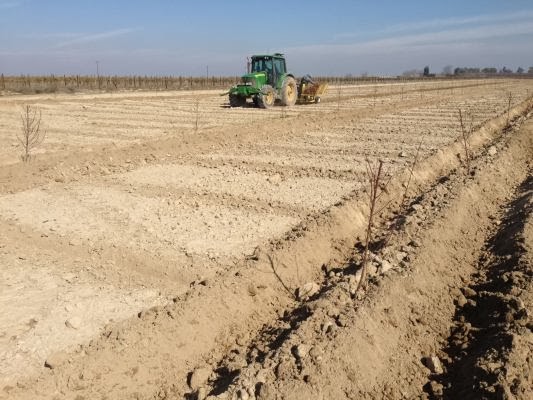
   It's been a busy week. I didn't make it to the Farm Show because we planted twenty acres of trees on Thursday. Preparing for that kept me going this week. The process of planting began two years ago when we tore out the old orchard and ordered these trees. 
They come off the truck in bins.
Then we load them on to the planter.
Look at them go.
They don't look like much now...
...and it will take a few years before they are producing.
   The first thing we did was heel them in. Then get them watered right away in those furrows you see here.. We will prune them next. Then we will add some fertilizer and give them lots of tender, loving care. This is a thirty year investment and we want these trees to be strong and happy.


   In other news, President Obama came to town to talk about the drought in California. I am not nearly a big enough fish to meet with the President. I did, however, throw in my two cents in an open letter to the President that was printed in the Fresno Bee and the Fresno Business Journal.


An Open Letter to President Obama-

First, Mr. President, thank you for coming to the Valley. This is important to us, and to all Californians. There is nothing like having leaders out in the field seeing things for themselves.

Mr. President, this is a multi-year problem that requires multi-year solutions.

We have been short of rain for a few years. It is catching everyone’s attention right now because it is affecting our cities, not just our farmers.

This is a political problem, not a technical problem. When President Theodore Roosevelt led in the creation of Western irrigation projects he said, the purpose of these projects was, “reclaiming the waste areas of the arid West…and creating new homes upon the land” (Roosevelt 411). Our predecessors built a system to take care of our water needs and we have mis-managed it. President Kennedy was here for the ground breaking of the San Luis Dam and spoke of how important this was for the citizens of the Valley. Now that reservoir is being squeezed off by the federal government.
           
If you want to know why we are suspicious of the Federal government you only have to look as far back as the Central Valley Project Improvement Act (CVPIA). The CVPIA took water from the irrigation system for the environment and promised to restore the capacity to the system within ten years. Twenty years later we are still waiting.

The 1998 Nobel Prize in Economics went to Amartya Sen who proved that famines were caused by governments, not by natural disasters. Sen wrote, “droughts may not be avoidable, but their affects can be” (Sen 123).

There are wet years and there are dry years in California. We are foolish because we do not save water from the wet years for the dry years. In 2009 we cut off water and the University of California reported 60,000 people lost their jobs. Howitt, et al).
A few years ago we had 160% normal rainfall. Farmers only got 80% of their water supply and 27 million acre feet of water ran out in to the ocean. Imagine what we could have done if we had saved even ten percent of that water.

Your administration is concerned about climate change. One way to lower our carbon foot print is to grow food near where it is consumed. There are over thirty million consumers within a few hundred miles of Central Valley farms. Help us secure our long term water supplies and we can help millions of people lower their carbon footprints by growing self, healthy and affordable food here in California. But, we need a reliable water supply.

This drought is a multi-year problem that will require multi-year solutions. In my book, Ten Reasons: Finding Balance On Environmental Issues, I make the case that we need a healthy environment and a healthy economy. Yes, let’s care for the environment. But, let’s feed and clothe our people too. We must manage our system so we can capture more rainfall during the wet years for the dry years.

Cordially,


Paul H. Betancourt
Kerman, California


Howitt, Richard, et al., http://ewccalifornia.org/reports/MeasuringEmploymentImpacts-092909.pdf

Roosevelt, Theodore, Theodore Roosevelt: An Autobiography, New York,
            De Capo Press, 1985.


Sen, Amartya, The Amartya Sen and Jean Dreze Omnibus, New Delhi,
            Oxford University Press, 1999.

I hope you all have a great week.

P